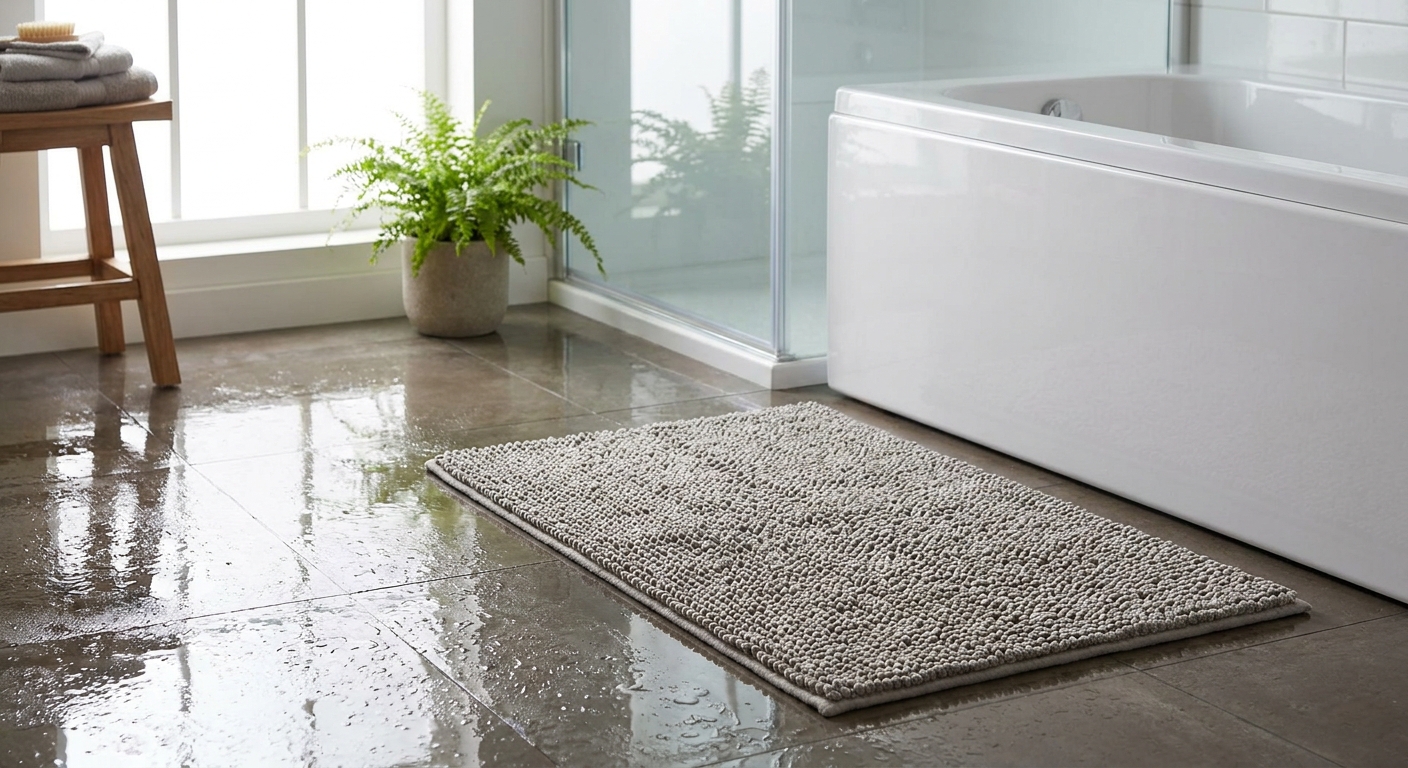
A slick bathroom floor turns a normal Tuesday morning into an ER visit waiting to happen, and the right bath mat for slippery floor problems is a grip issue first, absorbency second.
- A looped Turkish cotton bath rug with a rubber grid backing is the safe pick for a bath mat for slippery floor situations — Buy.
- Diatomite stone mats grip well dry but turn glassy once soap film builds up — Skip for daily bathroom use in 2026.
- Memory foam mats absorb fast but compress and lose backing traction after 12-18 months — Consider only with a slip-tested backing.
- Anything under 20x32 inches leaves the wet exit zone uncovered — Skip regardless of material.
Why this matters
Most bathroom falls happen in the two seconds between stepping out of the tub and reaching for a towel, not in the shower itself. The floor is wet, the foot is wet, and a flat cotton mat with no backing just slides with you. In 2026, the mats worth buying solve for grip first — everything else is secondary.
Superior Brand sells cotton-blend bath rugs as part of its bathroom textile line, and the same logic that governs a good bath mat governs a good bath rug: material alone doesn't stop a fall, backing does.
Who this is for
This guide is for anyone dealing with a bathroom floor that's genuinely dangerous when wet — tile, marble, or polished stone with little natural texture. That includes households with kids getting in and out of the tub unsupervised, older adults or anyone with balance or mobility limitations, and renters who can't install grab bars or re-tile but can control what's on the floor. If your bathroom floor already has textured, slip-rated tile, you have more flexibility on mat choice. If it's smooth and glossy, grip is non-negotiable.
What to look for in a bath mat for slippery floors
Backing material and suction grip
The backing, not the top surface, is what keeps a mat from sliding on wet tile. Look for a full rubber or PVC-dot backing rather than a thin non-slip coating sprayed on the underside — sprayed coatings wear off within a season of regular washing. A mat that stays flat and doesn't bunch when you step on it wet is doing its job.
Absorbency rate
A mat that stays wet on top keeps transferring water to bare feet, which recreates the slip risk it's supposed to solve. Cotton loop pile in the 1000-1500 GSM range wicks water into the fibers within seconds; thinner mats under 500 GSM leave surface moisture standing longer. Check drying time between uses, not just absorbency at first contact.
Thickness and cushioning
Too thin and the mat offers no traction over the underlying tile; too thick and it becomes a trip hazard at the edges, especially in bathrooms shared with young kids or older adults. A 0.5 to 1-inch pile height is the practical range for daily standing use without curling at the corners.
Size and floor coverage
A mat that only covers the immediate tub exit leaves the sink and toilet approach zones bare, and those are just as slippery after a shower. Measure the full wet-traffic path — tub to sink, tub to door — and size the mat (or mats) to cover it, not just the first step out.
Machine washability
A bath mat that can't handle weekly hot-water washing turns into a mildew and bacteria problem fast in a humid bathroom. Cotton-blend mats with a rubber backing rated for machine wash hold their grip through repeated laundering; foam-core mats often can't take a washer cycle without breaking down.
Mold and mildew resistance
Bathrooms run humid, and any mat that traps moisture underneath becomes a mildew source within weeks. A breathable weave with a perforated or grid-style rubber backing lets air move under the mat between uses, which matters more in bathrooms without strong ventilation.
Top picks by mat type
The safe pick: looped cotton bath rug with rubber grid backing. Full-contact rubber grid backing plus a cotton loop pile in the 1200 GSM range gives you both grip and absorbency in one mat. It machine washes on a hot cycle without the backing cracking. Verdict: Buy — this is the default choice for a genuinely slippery bathroom floor, and it pairs well with the kind of cotton-blend construction found in Superior Brand's bath rugs for kids' bathrooms, sized for the tub-to-door zone kids actually use.
The wildcard: diatomite stone mat. These absorb water almost instantly on contact and dry to the touch within a minute, which sounds like a win. The catch: once soap residue builds up on the stone surface, the grip drops sharply and the surface gets genuinely glassy. Verdict: Skip for households with kids or anyone with balance concerns — fine as a secondary mat next to the sink, not as the primary tub-exit mat.
The comfort pick: memory foam mat with non-slip backing. Soft underfoot and warm compared to cotton, memory foam is a real upgrade for cold-floor bathrooms. But foam compresses over 12 to 18 months of daily use, and once it flattens, the backing traction goes with it. Verdict: Consider only if you're prepared to replace it annually and you've confirmed the backing is rated for wet tile, not just carpet.
The budget trap: thin cotton mat with a sprayed-on non-slip coating. These look identical to the rubber-backed version in a photo, but the coating wears off after roughly 15-20 wash cycles and the mat starts sliding exactly when you need it not to. Verdict: Skip — the price difference isn't worth the fall risk once the coating is gone.
The spa-style pick: Turkish cotton bath rug paired with a bathrobe. For bathrooms doing double duty as a relaxation space, a heavier Turkish cotton rug holds up to daily traffic while still feeling upscale. If you're building out that spa feel, a spa-style bathrobe rounds out the routine without compromising on the grip the floor actually needs. Verdict: Buy for anyone treating the bathroom as more than a functional space.
What to avoid
- Decorative shag mats with no backing. They look plush in a photo but shift underfoot the moment they're wet — no rubber grid, no grip.
- Mats sized under 20x32 inches. Anything smaller leaves part of the wet-traffic path exposed, which defeats the purpose.
- Anything advertised only by thread count with no backing spec. A high thread count tells you about softness, not traction — don't let a soft-feel claim substitute for a stated non-slip backing.
Build out a safer, spa-style bathroom
Browse Superior Brand's bath textile line for the pieces that pair with a slip-safe mat.
Verdict comparison
| Mat type | Backing grip | Absorbency | Verdict |
|---|---|---|---|
| Looped cotton, rubber grid backing | High | High (1200 GSM range) | Buy |
| Diatomite stone | High when dry, drops with soap film | Very high | Skip for primary use |
| Memory foam, non-slip backing | Moderate, declines over 12-18 months | High | Consider |
| Thin cotton, sprayed coating | Low after 15-20 washes | Moderate | Skip |
| Turkish cotton, heavier pile | High | High | Buy |
FAQ
What is the best bath mat for a slippery floor in 2026?
A looped cotton bath rug with a full rubber grid backing is the best bath mat for slippery floor problems in 2026 because the backing, not the top material, controls traction on wet tile. Diatomite and thin sprayed-coating mats fall short once soap residue builds up.
Are memory foam bath mats safe on slippery tile?
Memory foam bath mats are safe on slippery tile only if the backing is specifically rated for wet-floor traction, not carpet use. Foam compresses within 12 to 18 months of daily use, which reduces grip over time.
How often should you replace a bath mat?
Replace a rubber-backed cotton bath mat every 1 to 2 years, or sooner if the backing feels smooth instead of grippy. Sprayed-coating mats often need replacing within 15 to 20 wash cycles once the coating wears off.
Do bath mats need to be machine washable?
Yes, a bath mat needs to survive weekly hot-water machine washing to prevent mildew buildup in a humid bathroom. Foam-core mats that can't take a washer cycle break down faster and trap bacteria.
What size bath mat covers a slippery bathroom floor properly?
A bath mat at least 20x32 inches covers the immediate tub-exit zone, but bathrooms with a longer wet-traffic path from tub to sink need a second mat or a runner to cover the full route. Undersized mats leave the most dangerous stretch of floor bare.
Is a diatomite stone mat better than a cotton bath mat?
A diatomite stone mat dries faster than cotton but loses grip once soap film coats the surface, making it a weaker primary choice for a genuinely slippery floor. Cotton with a rubber grid backing holds traction more consistently across daily use.
Can a bath mat prevent bathroom falls?
A properly backed bath mat significantly reduces slip risk in the tub-exit zone, but it doesn't replace grab bars or textured flooring for households with mobility concerns. Backing quality matters more than any single material claim.
One last thing
The detail most shoppers skip: check the backing after the mat has been through five or six wash cycles, not on day one. A rubber grid backing that still feels tacky to the touch after repeated hot-water washing is the real signal of a mat that will hold up through 2026 and beyond — a smooth-feeling backing out of the box is not a reliable predictor either way.