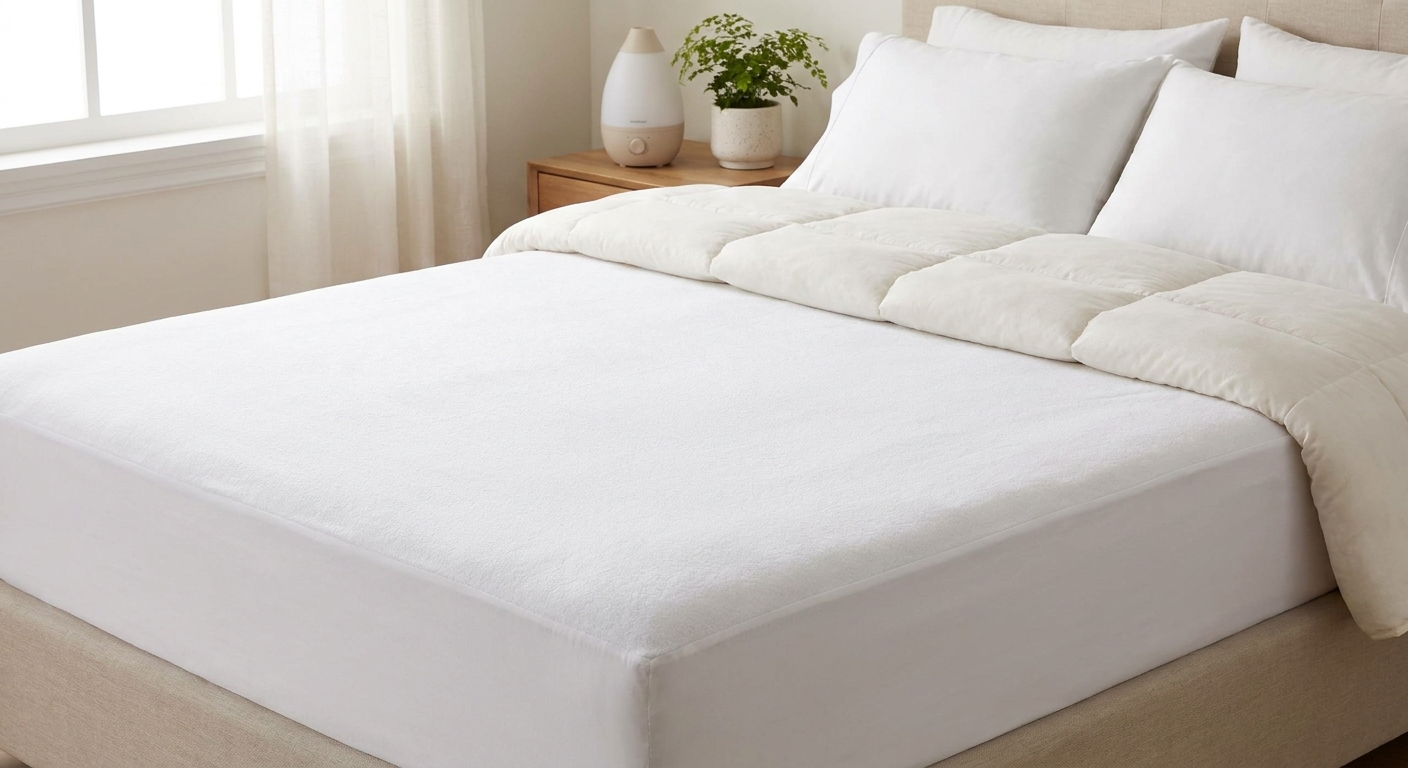
Dust mites, pet dander, and mold spores collect in mattress fibers faster than most people realize — and if you wake up congested, itchy, or sneezing, the mattress protector on your bed for 2026 is either doing its job or actively working against you.
- Zippered six-sided encasement is the best mattress protector for allergies in 2026 — buy it over any top-only pad.
- 100% waterproof membrane protectors block dust mite allergens and pet dander; down-alternative quilted pads trap them instead.
- Organic cotton woven protectors suit sensitive skin without vinyl or plastic film against your body.
- Pair a mattress encasement with a zippered pillow protector — allergens collect in pillows just as fast.
- Skip bamboo-rayon protectors marketed on softness alone until the allergen barrier claim is specified in GSM or pore size.
Why this matters
Dust mites feed on shed skin cells and thrive in mattress fibers where temperature and humidity stay steady overnight. A mattress that's five years old can hold ten times more dust mite allergen than a new one, according to aggregated allergy-research summaries cited across 2026 home health guides.
A mattress protector isn't a comfort layer — it's a barrier. The weave has to be tight enough to stop mite waste particles (roughly 10-40 microns) while still letting the mattress breathe. That's the entire game, and most protectors on shelves in 2026 fail on one side or the other.
Superior Brand builds bedding and protective textiles around that tradeoff — three generations of textile craftsmanship, not a single-season private-label run. The pillow protectors for allergies guide covers the pillow half of this problem, because a mattress encasement without a matching pillow protector leaves half the allergen source exposed.
How we ranked
Each protector type below is scored against four criteria that matter for allergy control specifically: barrier completeness (does it cover all six sides or just the top), allergen pore size, breathability, and wash durability at high heat — dust mites die at 130°F (54°C), and a protector that can't survive repeated hot washes stops protecting within a season. Marketing claims without a stated pore size or material spec get flagged as Wait, not Buy, regardless of how the product photographs.
The ranked list
1. Zippered six-sided encasement — the essential pick
A full encasement zips around the entire mattress, not just the top surface, sealing allergens already living inside older mattresses instead of just catching new ones. This is the only design that fully isolates a mattress from dust mite waste on all sides, which matters because mites migrate through fabric, not just settle on top. Verdict: Buy — this is the baseline for anyone with a diagnosed dust mite allergy in 2026.
2. 100% waterproof membrane protector — the pet-owner's answer
A TPU (thermoplastic polyurethane) membrane blocks liquid and dander at the surface without the crinkle or heat-trap of older vinyl laminates. Pet dander is smaller than dust mite allergen and needs a tighter membrane pore size to stop it from working through a woven-only fabric. The mattress protectors for pet owners guide breaks down the difference between a stain-only barrier and one that actually blocks dander transfer. Verdict: Buy for households with cats or dogs sleeping on the bed.
3. Organic cotton woven protector — the sensitive-skin choice
A tightly woven organic cotton surface (no vinyl, no plastic film against skin) suits anyone whose allergy symptoms include skin irritation, not just respiratory ones. The weave density does the allergen-blocking work instead of a laminate layer, which keeps the surface breathable through a full night's sleep. Details on fiber sourcing and weave density live in the organic cotton bedding for sensitive skin guide. Verdict: Buy if skin reactivity is part of the symptom picture.
4. Cotton terry surface with waterproof backing — the middle ground
This hybrid puts a soft terry loop cotton face over a waterproof backing layer, giving you a mattress-pad feel with allergen-barrier function underneath. It's quieter than a membrane-only protector and machine-washes well at 130°F, but it only covers the top of the mattress, not the sides. Verdict: Consider as a second layer over a full encasement, not a replacement for one.
5. Kids' waterproof protector with reinforced seams — the family pick
Kids' beds need a protector that survives accidents and hot-water washes without seam failure, since a torn seam turns a barrier protector into a gap allergens pass straight through. Reinforced double-stitched seams and a fitted elastic skirt keep the barrier intact through 2026's average wash frequency for a child's bed — closer to weekly than the adult-bed norm. The waterproof mattress protectors for kids' beds guide covers sizing and seam construction in detail. Verdict: Buy for any child's bed, allergy or not.
6. Down-alternative quilted protector — the cozy trap
Quilted poly-fill protectors feel plush, but the loose fill and stitched channels create more surface area for dust mites to colonize, not less. Unless the quilting is bonded to a sealed waterproof backing, this style adds allergen real estate instead of removing it. Verdict: Skip for allergy control, even though it's often the top seller by feel alone.
7. Bamboo-rayon protector — the marketing pick
Bamboo-derived rayon markets itself on softness and "naturally hypoallergenic" language, but rayon is a processed fiber, not a woven barrier, and most bamboo-rayon protectors don't publish a pore size or membrane spec at all. Without that number, there's no way to verify the allergen claim against a dust mite's 10-40 micron size range. Verdict: Wait until the listing states an actual barrier spec, not just a fiber name.
8. Matching pillow protector — the pair you can't skip
A mattress encasement without a pillow protector leaves the other major allergen reservoir in the bed untouched — pillows collect dust mite waste and dander just as fast as mattresses do, sometimes faster given nightly contact with skin and hair. The pillow protectors for allergies guide walks through zippered versus slip-style options. Verdict: Buy alongside any mattress protector purchase, not as an afterthought.
Build a full allergen barrier
Shop mattress and pillow protectors sized for every bed in the house.
Comparison table
| Type | Barrier coverage | Best for | Wash durability | Verdict |
|---|---|---|---|---|
| Zippered six-sided encasement | Full (all sides) | Diagnosed dust mite allergy | High, 130°F rated | Buy |
| Waterproof TPU membrane | Top and sides | Pet owners | High | Buy |
| Organic cotton woven | Top-only, dense weave | Sensitive skin | Moderate-high | Buy |
| Cotton terry + waterproof backing | Top-only | Layering over encasement | High | Consider |
| Kids' reinforced waterproof | Top and skirt | Children's beds | High, frequent wash | Buy |
| Down-alternative quilted | Top-only, loose fill | Comfort, not allergy control | Moderate | Skip |
| Bamboo-rayon | Top-only, unverified spec | Unclear until specs published | Unverified | Wait |
Where to buy
- Check for a stated pore size or membrane type before checking out — "hypoallergenic" with no spec attached is a marketing word, not a barrier guarantee.
- Confirm the zipper has a flap cover. An exposed zipper on a six-sided encasement is a gap allergens pass through nightly.
- Buy from a source that ships and restocks reliably — a protector that wears out in one season and can't be reordered fast defeats the point. Superior Brand ships free via ground shipping to the 48 contiguous US and runs Superior Rewards, where every dollar spent earns a point toward the next reorder.
FAQ
What is the best mattress protector for allergies in 2026?
A zippered six-sided encasement is the best mattress protector for allergies in 2026 because it seals the entire mattress, not just the top surface, against dust mite waste and pet dander. Top-only protectors leave the sides and bottom exposed to allergens already living inside the mattress.
Is a waterproof mattress protector better than a cotton one for allergies?
A waterproof membrane protector blocks dust mite allergen and pet dander at a tighter pore size than most woven cotton fabrics alone. A tightly woven organic cotton protector still works well for allergy control and suits sensitive skin better than a plastic-film surface.
How often should you wash a mattress protector for allergies?
Wash a mattress protector every one to two weeks at 130°F or higher, since that's the temperature that kills dust mites. Kids' beds and pet-owner households should wash weekly given faster allergen buildup.
Do mattress protectors actually stop dust mites?
A protector with a pore size under 10 microns stops dust mite waste particles from passing through, which is the actual allergen trigger, not the mites themselves. A protector without a stated pore size or membrane spec hasn't demonstrated it does this.
Are bamboo mattress protectors good for allergies?
Bamboo-rayon protectors are marketed as hypoallergenic but rarely publish a pore size or barrier spec, so the allergy claim can't be verified against dust mite size ranges. Wait for a listing that states the actual membrane or weave spec before buying on the bamboo claim alone.
Do you need a pillow protector along with a mattress protector for allergies?
Yes — pillows collect dust mite waste and dander at the same rate as mattresses given nightly skin and hair contact. A mattress encasement without a matching zippered pillow protector leaves a major allergen source untouched.
How much does a mattress protector for allergies cost?
Pricing varies by size and barrier type, so check current listings for exact figures rather than relying on a fixed range. Six-sided encasements typically cost more than top-only pads given the added fabric and zipper construction.
Can a mattress protector help with asthma symptoms too?
A full encasement that blocks dust mite allergen reduces one of the most common asthma triggers in bedrooms, since inhaled mite waste particles are a documented respiratory irritant. It won't address other asthma triggers like mold or smoke, so treat it as one layer of a larger air-quality approach.
One last thing
The detail most shoppers skip: check whether the zipper pull has a small fabric flap sewn over it. Without that flap, the zipper teeth themselves sit exposed against the mattress seam — the one gap in an otherwise sealed six-sided design, and the exact spot allergens work through first.