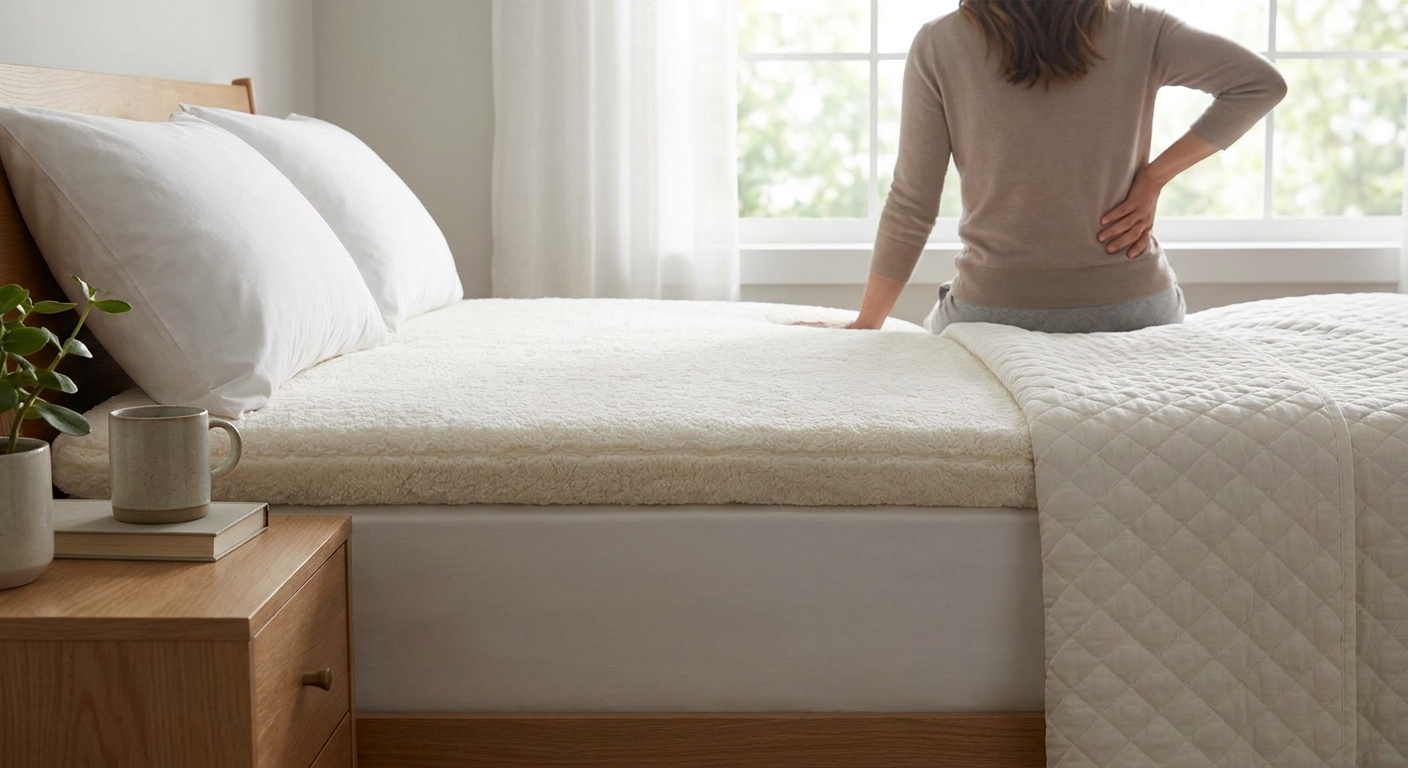
A mattress topper for back pain lives or dies on density and thickness, not marketing copy — here's how the six major topper types actually perform and what to pair with your bed instead of guessing.
- A 5 lb/ft3, 4-inch memory foam topper is the safest buy for chronic lower back pain in 2026 — Buy.
- Talalay latex at 3 inches suits stomach and side sleepers who need lift without sinking — Consider.
- Wool toppers under 2 inches feel plush but skip them if spinal support is the goal — Skip.
- Featherbed toppers collapse fast at low fill weight — Skip for back pain, fine for guest rooms.
- Pair any topper with a fitted mattress protector to stop sag and keep the surface breathable.
Why this matters
Back pain from a mattress usually comes from one of two failures: the surface is too soft and the spine sinks out of alignment, or it's too firm and pressure builds at the shoulders and hips. A topper doesn't fix either problem by being "plush" — it fixes it by matching density to your sleep position.
If your back pain shows up specifically when you lie flat — often tied to acid reflux — the fix isn't a topper at all. A wedge pillow for sleeping upright changes the angle of your spine and chest instead of the cushioning underneath it, and it solves a different problem than a topper ever will.
For everyone else, density (measured in lb/ft3) and thickness (measured in inches) determine whether a topper actually supports the lower back through 2026's typical 7-to-9-year mattress replacement cycle, or just adds a soft layer that sags by month eight.
How we ranked
Each topper type below is ranked on four factors: density and thickness specs published across major topper manufacturers in 2026, edge and center support behavior, temperature retention, and how well the category holds up under nightly use for 12+ months. This isn't a single-brand product test — it's a category comparison, so use it to shop smart regardless of where you buy the topper itself. Superior Brand doesn't manufacture toppers, but the bedding layers around one — protectors, sheets, and pillows — change how well any topper performs long-term.
The ranked list
1. Memory foam topper (5 lb/ft3, 4 inches) — the pressure-point specialist
High-density memory foam at 5 lb/ft3 and 4 inches thick is the category standard for back pain relief in 2026 because it contours around the lumbar spine instead of pushing back against it. Lower-density foam (under 3 lb/ft3) sags within a year and stops doing this job. Expect a slower response time — foam that reacts too fast doesn't cradle the lower back the same way. Heat retention is the real trade-off here, so a breathable mattress protector underneath keeps the surface from trapping warmth while also protecting the foam from spills that void most topper warranties. Verdict: Buy for chronic lower back pain, especially for back and combination sleepers.
2. Latex topper (Talalay, 3 inches) — the bounce-back pick
Latex responds instantly instead of slowly conforming, which gives it more lift under the hips than memory foam. That responsiveness matters for pillows for side sleepers users too, since side sleepers need a surface that doesn't let the shoulder sink past the hip line. A 3-inch Talalay layer is thick enough to matter but won't turn a firm mattress into a soft one overnight. Natural latex also resists the sag that plagues lower-density foam by year two. Verdict: Consider if you sleep on your side or switch positions through the night.
3. Gel-infused memory foam (3–4 inches, 4 lb/ft3) — the cool sleeper's compromise
Gel infusion doesn't change support, it changes temperature — the gel channels pull heat away from the body faster than standard foam. That matters because hot sleepers often shift positions at night trying to cool down, which undoes whatever spinal alignment the topper was providing. If overheating is your main complaint, silk bedding for hot sleepers on top of a gel topper does more for temperature than upgrading foam density alone. Verdict: Consider for back pain sufferers who also run hot at night.
4. Hybrid foam-and-fiber topper (2–3 inches) — the budget stopgap
These blend a thin foam core with polyester fiber fill to hit a lower price point. The support is real but shallow — 2 inches of foam can't do what 4 inches does, and the fiber layer compresses within the first six months. It's a reasonable bridge if you're replacing a mattress within the next year and just need to survive until then. Verdict: Hold — buy only as a short-term fix, not a long-term back pain solution.
5. Wool topper (1.5–2 inches) — the plush layer, wrong job
Wool regulates temperature better than almost any other topper material and feels genuinely luxurious against the skin. What it doesn't do is add real support — at 1.5 to 2 inches, wool is a comfort layer, not a spinal-alignment layer. It's the right call for someone who sleeps cold and wants softness. It's the wrong call for someone whose back hurts every morning. Verdict: Skip if back pain is the primary complaint.
6. Featherbed / down-alternative topper (2–3 inches, low fill weight) — the hotel-bed feel
This is the topper that feels incredible in a showroom and disappoints by week three. Low fill weight means it compresses fast under body weight, and once it flattens there's no support left underneath the softness. It's built for the sensation of a hotel bed, not for correcting spinal alignment over months of nightly use. Verdict: Skip for back pain — fine for a guest room refresh, not for your primary mattress.
Comparison table
| Topper Type | Density / Thickness | Best For | Price Tier | Verdict |
|---|---|---|---|---|
| Memory foam | 5 lb/ft3, 4 in | Chronic lower back pain | Mid to premium | Buy |
| Talalay latex | 3 in | Side/combination sleepers | Premium | Consider |
| Gel-infused foam | 4 lb/ft3, 3–4 in | Back pain + hot sleepers | Mid to premium | Consider |
| Hybrid foam-fiber | 2–3 in | Short-term budget fix | Budget | Hold |
| Wool | 1.5–2 in | Temperature, not support | Mid | Skip |
| Featherbed | 2–3 in, low fill | Plush feel, guest rooms | Budget | Skip |
Where to buy
- Check the density spec, not the firmness label. "Medium-firm" means nothing without a lb/ft3 number attached — request it before buying.
- Buy a protector at the same time as the topper. A fitted mattress protector keeps foam from absorbing moisture and voiding the manufacturer's warranty within the first year.
- Match your sheets to the new height. Adding 3 to 4 inches of topper means your fitted sheets need deeper pockets — check this before you buy new bedding to go with it.
If sensitive skin is part of the equation, organic cotton bedding sits directly against the body better than synthetic-blend sheets, especially once you've added a foam layer that already runs warm. Superior Brand ships free to the 48 contiguous US on qualifying bedding orders, and Superior Rewards members earn 1 point per dollar toward future orders — useful once you're replacing protectors and sheets alongside a new topper.
Refresh the bedding around your topper
Free ground shipping to the 48 contiguous US on qualifying orders.
FAQ
What's the best mattress topper for back pain in 2026?
A 5 lb/ft3, 4-inch memory foam topper is the strongest all-around pick for back pain in 2026 because it contours the lumbar spine without sagging within a year. Talalay latex at 3 inches is the runner-up for side and combination sleepers.
Is a firmer or softer mattress topper better for back pain?
Neither extreme wins — density matters more than firmness labels. A 4-inch, 5 lb/ft3 memory foam layer supports the lower back better than either a soft featherbed or an overly firm hybrid layer.
How thick should a mattress topper be for lower back pain?
4 inches is the sweet spot for real spinal support; anything under 2 inches functions as a comfort layer, not a support layer. Thicker isn't always better if the density is low.
Do gel-infused toppers help with back pain?
Gel infusion addresses temperature, not spinal alignment, so it helps indirectly by preventing the position-shifting that comes from overheating. Pick gel foam specifically if heat, not support, is your main complaint.
Can a mattress topper fix a sagging mattress?
A topper can mask a sagging mattress temporarily but won't fix the underlying structure — foam and latex toppers add support on top, they don't restore coils or foam that's already broken down. Replace the mattress if the sag is over an inch.
How long does a memory foam topper last?
A 5 lb/ft3 memory foam topper typically holds its support for 3 to 5 years with a protector on top; lower-density foam under 3 lb/ft3 often sags within 12 to 18 months.
Should side sleepers with back pain use a different topper than back sleepers?
Yes — side sleepers generally do better with 3-inch latex for the extra lift at the hip and shoulder line, while back sleepers benefit more from 4-inch memory foam's deeper contouring.
Do I need a mattress protector under a topper?
A fitted mattress protector under the topper prevents moisture absorption that voids most topper warranties and keeps the foam breathable longer. Skip it and most foam toppers show yellowing or odor within the first year.
One last thing
Most topper complaints filed in 2026 aren't about the foam failing — they're about heat and moisture trapped between the topper and a bare mattress, which breaks down foam cells faster than normal wear ever would. The fix costs less than the topper itself: a breathable protector and sheets sized for the added height solve more back-pain complaints than swapping topper brands does.