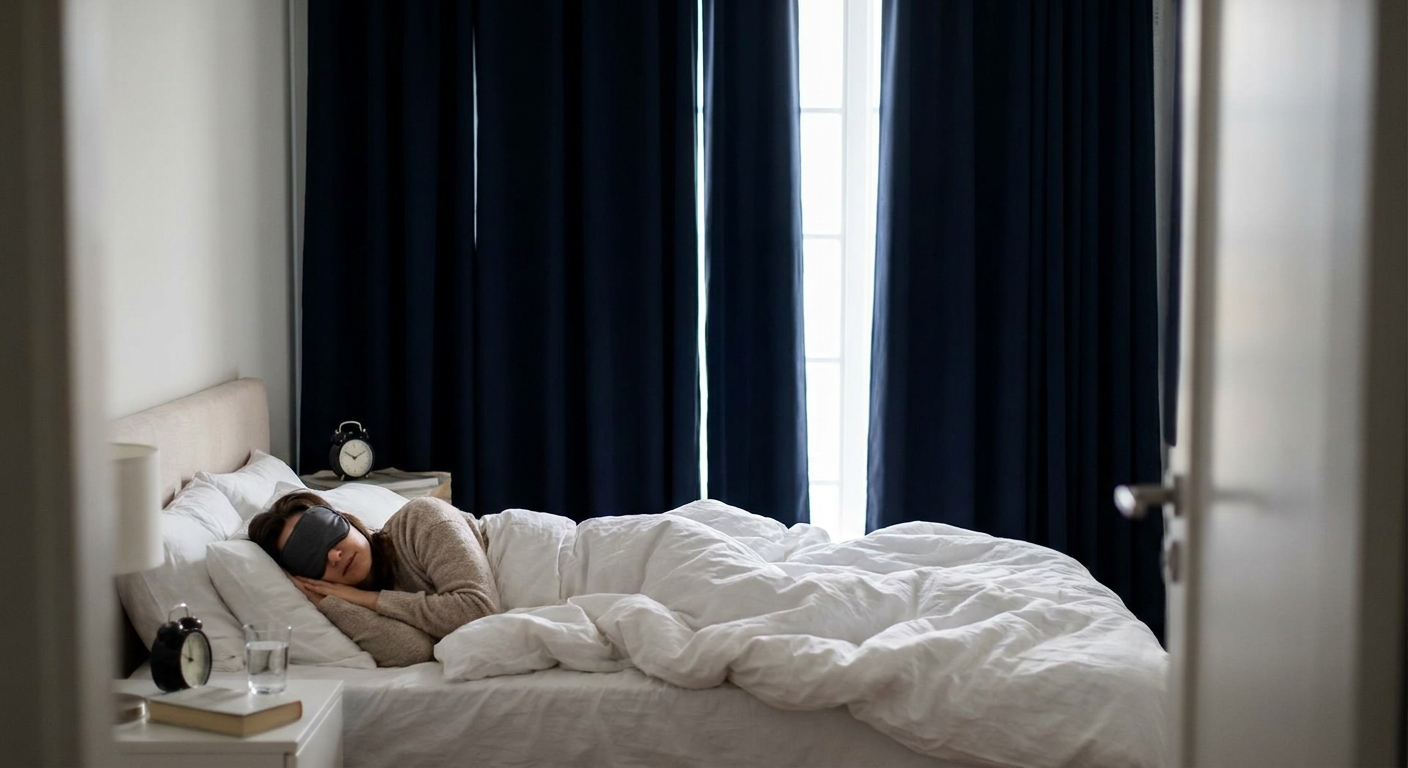
Shift workers trying to sleep at 2 p.m. face a problem daytime employees never think about: the sun doesn't care about your schedule, and neither does your neighbor's porch light. The right blackout curtains for shift workers turn a bright bedroom into a dark cave on command, any hour of the day.
- Triple-weave blackout panels blocking 99-100% of light are the safe pick for shift workers in 2026 — Buy.
- Layered blackout plus thermal liner adds noise dampening for day sleepers near traffic — Buy.
- Curtains must extend 4-8 inches past the window frame on each side or light leaks around the edges regardless of fabric.
- Skip anything labeled 'room darkening' instead of 'blackout' — that wording usually means 80-90% blockage, not full dark.
Why this matters
Roughly 16% of full-time US workers clock evening, night, or rotating shifts, according to Bureau of Labor Statistics survey data. That's a large population sleeping against biology, and light exposure during daytime sleep is the single biggest disruptor of that sleep.
Even a sliver of daylight around a curtain edge can suppress melatonin production and cut deep sleep short. Regular curtains marketed as "room darkening" typically block 80-90% of light — good enough for a nap, not good enough for someone who needs eight hours at noon, five days a week.
The fix isn't complicated, but it's specific. You need fabric weave, width, and mounting that together get you to near-total darkness, not just a dimmer room.
Who this is for
This guide is for nurses, EMTs, factory workers, warehouse staff, call center employees, and anyone else sleeping on a schedule that runs opposite the sun. If you've tried regular curtains and still wake up when the sun hits your window at 7 a.m., you're the target buyer here — you need blackout curtains for shift workers, not decorative drapes that happen to be dark colored.
Superior Brand carries curtains alongside bedding and bath textiles built for people optimizing sleep environments, which is the same logic that applies to picking the right blackout panel.
What to look for in blackout curtains for shift workers
Total light blockage percentage
Look for fabric rated at 99-100% light blockage, not "room darkening," which typically caps around 80-90%. For a shift worker sleeping at noon, that 10-20% gap is the difference between a dark room and one lit like dusk.
Triple-weave or bonded fabric construction
Triple-weave curtains use three layers woven together rather than a thin blackout liner sewn to a decorative front. That construction is what actually gets you to 99%+ blockage and holds up to daily opening and closing for years, not months.
Width coverage past the window frame
Curtains need to extend 4-8 inches beyond each side of the window frame and overlap in the middle when closed. Light doesn't need much room to sneak in — a curtain sized exactly to the window frame will leak light down both sides no matter how dense the fabric is.
Noise dampening layer
Shift workers sleeping during the day deal with traffic, lawn crews, and delivery trucks that night-shift sleepers never hear. A layered blackout curtain with a thermal or acoustic liner cuts ambient noise along with light, which matters more for day sleepers than anyone else.
Grommet or rod-pocket top with minimal gap
The top of the curtain is where most light escapes, even on otherwise excellent panels. Grommet tops that sit flush against the rod, or a rod-pocket style paired with a valance, close that gap better than clip rings.
Washability for daily-use bedrooms
A curtain that lives in a bedroom used for sleeping during smoke, cooking smells, or pet dander needs to survive a washing machine. Machine-washable blackout fabric that doesn't lose its coating after a few cycles is worth paying for over a dry-clean-only panel.
Top picks
Triple-Weave Blackout Panels — the safe pick Blocks 99-100% of light through a genuine three-layer weave rather than a bonded liner. This is the default choice for most bedrooms and holds up through 2026 and beyond with normal washing. Verdict: Buy.
Layered Blackout + Thermal Liner — the noise fighter Adds a second fabric layer that dampens sound along with light, useful if your bedroom faces a street or a shared wall. Slightly bulkier to hang, but the acoustic benefit is real for anyone sleeping through daytime traffic. Verdict: Buy.
Extra-Wide Patio Blackout Curtains — the wildcard Built for sliding glass doors and covers up to 100 inches of width in a single panel set, which matters if your bedroom has a patio door instead of a standard window. Overkill for a small bedroom window, essential if you've got a slider. Verdict: Consider.
Blackout Curtain Clip-On Liners — the budget patch Clips onto curtains you already own and adds roughly 90% blockage without replacing the whole setup. A reasonable stopgap if you're renting or not ready to commit to full panels, but it won't hit true blackout numbers on its own. Verdict: Consider.
White or Light-Colored Blackout Panels — the daytime look Same 99% blockage as darker colors, despite what the fabric looks like from outside. Good option if you don't want your bedroom looking like a cave during the hours you're actually awake. Verdict: Buy.
Find blackout curtains that fit your window
Browse curtain sizes and fabrics built for full-room darkening.
What to avoid
- "Room darkening" labeled as blackout. These terms aren't interchangeable — room darkening tops out around 80-90% blockage, which still lets in a visible glow during peak daylight hours.
- Curtains sized exactly to the window frame. No overlap and no side coverage means light leaks down both edges regardless of fabric density.
- Thin single-layer fabric with a coating. A sprayed-on blackout coating degrades faster than a woven triple-layer fabric and often loses effectiveness after repeated washing.
Verdict comparison
| Pick | Light Blockage | Best For | Verdict |
|---|---|---|---|
| Triple-Weave Blackout Panels | 99-100% | Standard bedroom windows | Buy |
| Layered Blackout + Thermal Liner | 99-100% | Noisy streets, shared walls | Buy |
| Extra-Wide Patio Blackout Curtains | 99-100% | Sliding glass doors | Consider |
| Blackout Curtain Clip-On Liners | ~90% | Renters, budget fix | Consider |
| White/Light Blackout Panels | 99% | Daytime aesthetic | Buy |
FAQ
What's the best blackout curtain for shift workers in 2026?
Triple-weave blackout panels rated at 99-100% light blockage are the best overall choice for shift workers in 2026. Add a thermal liner if daytime noise from traffic is also a problem.
How much light do blackout curtains actually block?
True blackout curtains with triple-weave construction block 99-100% of light. Curtains labeled 'room darkening' instead of 'blackout' typically only block 80-90%.
Is room darkening the same as blackout?
No — room darkening fabric blocks roughly 80-90% of light, while blackout fabric blocks 99-100%. For daytime sleep after a night shift, that gap is noticeable.
How wide should blackout curtains be for a shift worker's bedroom?
Curtains should extend 4-8 inches beyond each side of the window frame and overlap slightly in the center when closed. Sizing to the exact window frame leaves light gaps along both edges.
Do blackout curtains help with noise as well as light?
Layered blackout curtains with a thermal or acoustic liner reduce ambient noise along with light, which matters most for people sleeping during daytime traffic and yard work. Single-layer blackout fabric blocks light well but does little for sound.
Can I add blackout lining to curtains I already own?
Yes, clip-on blackout liners retrofit existing curtains and add roughly 90% light blockage without replacing the panels. They won't match full blackout panel performance, but they're a reasonable fix for renters.
Are white blackout curtains as effective as dark ones?
Yes, white and light-colored blackout curtains block the same 99% of light as darker colors when built with the same triple-weave construction. The color affects appearance, not blockage performance.
How often should blackout curtains be washed?
Machine-washable blackout curtains can typically go through a normal wash cycle every one to two months without losing their light-blocking coating. Check the care label, since some coated fabrics degrade faster than triple-weave construction.
One last thing
The top of the curtain, not the fabric itself, is where most shift workers lose the darkness fight. A grommet top that sits flush against the rod closes the gap that clip rings and loose rod pockets leave wide open — swap the hardware before you swap the curtain, and you might solve the problem for a fraction of the cost.