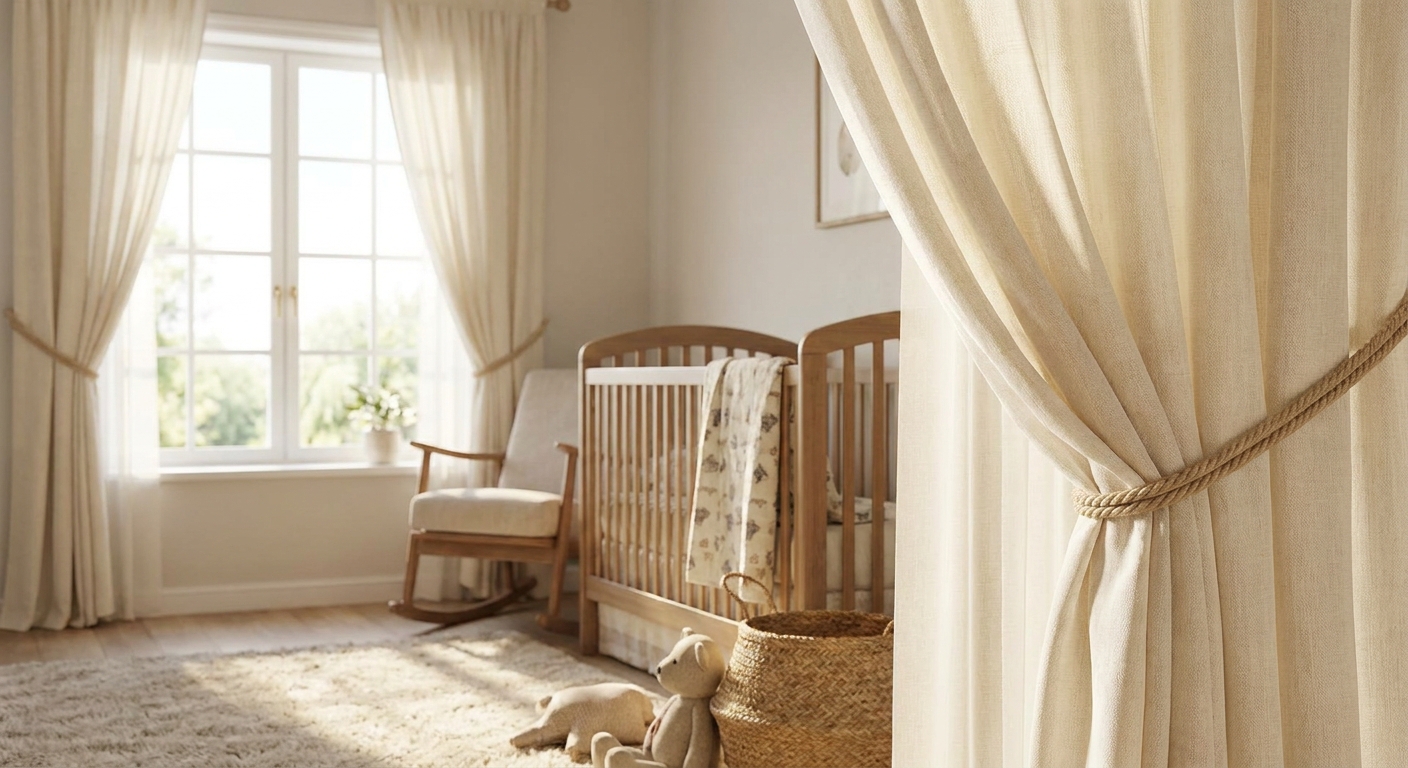
A nursery needs total darkness for naps that actually stick, fabric that survives spit-up and a fast wash cycle, and a curtain that still looks put-together in a room built for a newborn in 2026. This guide ranks the curtain types that deliver on all three, not just the ones that look good in a catalog photo.
- 100% blackout triple-weave curtains are the safe pick for best curtains for nursery in 2026 — buy them for any room with a 6 a.m. sunrise problem.
- Thermal-lined cotton-blend panels hold a room within 3-4 degrees of the rest of the house, which matters for a baby who can't ask for a blanket.
- Skip lightweight single-layer polyester panels under 150 GSM — they block light poorly and pill within a season of washing.
- Machine-washable blackout curtains save a laundry-room trip during the newborn stretch when spit-up and diaper blowouts hit fabric daily.
Why this matters
Newborns sleep in 45- to 90-minute cycles and light is the single biggest disruptor of that cycle once a baby starts producing melatonin around 3 months old. A curtain that lets in a streetlamp glow or a 5 a.m. sunrise doesn't just annoy a parent — it shortens naps and pushes bedtime later.
Nursery fabric also takes more abuse than any other room in the house. Formula spills, humidifier mist, and a toddler yanking on the hem all shorten the life of a cheap panel fast. The fabric weight and weave matter more here than in any other bedroom — a nursery curtain earns its keep on darkness, durability, and how many times it survives the wash before it looks tired.
How this list was ranked
Each curtain type below was scored against three factors that matter specifically in a nursery: light-blocking performance (how close to full blackout the weave gets), fabric durability under frequent washing, and ease of care for a room that gets cleaned more than any other in the house. Fabric weight in GSM (grams per square meter) is used as the proxy for blackout performance, since a denser weave blocks more light regardless of color. Pricing patterns and material notes reflect what's typical across home textile retailers heading into 2026, not a single storefront's catalog.
The ranked list
1. 100% blackout triple-weave curtains — the naptime non-negotiable
Triple-weave blackout fabric runs 280-320 GSM and blocks roughly 99% of incoming light when panels are hung wide enough to overlap the window frame by 3-4 inches on each side. That overlap detail is what separates a curtain that actually darkens a room from one that just looks dark from across the street.
For a nursery, this is the fabric type doing the heaviest lifting on nap consistency. A full guide to blackout curtains for bedrooms breaks down how to measure for that overlap and pick the right rod width. Verdict: Buy — this is the baseline standard for any nursery in 2026.
2. Thermal-lined cotton-blend panels — the temperature regulator
A thermal liner adds a second fabric layer behind the face fabric, which keeps a nursery within 3-4 degrees of the rest of the house even against a drafty single-pane window. Cotton-blend face fabric in the 200-250 GSM range breathes better against a humidifier-heavy room than a full polyester weave.
This is the pick for nurseries in older homes or anywhere the HVAC vent doesn't quite reach. It costs more up front than a single-layer panel but earns it back in fewer space-heater hours. Verdict: Buy for drafty rooms, Consider everywhere else.
3. Grommet-top blackout panels — the easy hang
Grommet tops slide onto a rod without hooks or clips, which matters when a curtain change happens at 11 p.m. during a diaper blowout. The metal grommet ring itself doesn't affect blackout performance — that's still a function of the fabric weave underneath — but it cuts install and removal time by roughly half compared to a rod-pocket panel.
Look for fabric referencing OEKO-TEX sourcing standards if a low-emission textile matters to the household, since a nursery is one of the more frequently touched rooms in the home. Verdict: Buy for anyone prioritizing quick swaps over a formal pleated look.
4. Layered sheer-plus-blackout double-rod panels — the flexible dimmer
A double-rod setup runs a sheer panel on the inner rod and a blackout panel on the outer rod, giving a parent two settings: filtered daylight for playtime, full dark for naps. It requires two rods and roughly double the fabric investment of a single blackout panel.
The upside shows up during the toddler stretch, when a nursery becomes a playroom half the day and a sleep space the other half. Compare it against the blackout curtains built for shift workers, which use a similar double-layer logic for daytime sleepers. Verdict: Consider if the room pulls double duty; Skip if the nursery is sleep-only.
5. Extra-long blackout panels for high ceilings — the tall-window fix
Standard panels run 84-96 inches; a room with an 8-foot-plus ceiling or a window that starts near the crown molding needs a 108-inch or longer panel to avoid a gap at the floor that leaks light. That gap is the most common reason a "blackout" curtain fails to actually black out a room.
Measure floor-to-rod before ordering anything shorter than 108 inches in a room built before 2010, since older construction tends to run taller ceilings than newer builds. Verdict: Buy for high-ceiling rooms; standard length works fine for anything under 8 feet.
6. Machine-washable blackout curtains — the easy-clean pick
A nursery curtain gets touched, grabbed, and occasionally used as a tissue by a toddler, so machine-washability isn't a nice-to-have — it's the difference between a curtain that lasts through year three and one that gets replaced after a single formula spill sets in. Fabric blends with organic cotton content tend to hold color and shape better across repeated wash cycles than a straight polyester weave.
For households managing sensitive skin concerns alongside a new baby, the same fabric logic shows up in organic cotton bedding for sensitive skin — lower-processing cotton blends tend to be gentler across textiles, not just sheets. Verdict: Buy for any household doing more than one load of nursery laundry a week.
Comparison table
| Curtain type | Light-blocking | Best for | Verdict |
|---|---|---|---|
| 100% blackout triple-weave | ~99% | Any nursery, any season | Buy |
| Thermal-lined cotton-blend | ~95% + insulation | Drafty rooms, older homes | Buy |
| Grommet-top blackout | ~99% (fabric-dependent) | Fast, frequent hangs | Buy |
| Layered sheer + blackout | Adjustable | Playroom/nursery combo | Consider |
| Extra-long blackout | ~99% with correct overlap | High ceilings, tall windows | Buy |
| Machine-washable blackout | ~95-99% | Frequent-wash households | Buy |
Where to buy
- Confirm the GSM before checking out. Anything under 200 GSM in a "blackout" listing is usually a light-filtering panel with a blackout liner sewn in, not true triple-weave fabric.
- Check for free shipping terms before adding two rods' worth of panels to a cart — retailers shipping free ground service to the 48 contiguous US save real money on a double-rod setup, since curtain panels are bulky to ship.
- Ask about a rewards or points program if this is one of several nursery purchases. A program structured at $1 spent per point (Superior Rewards runs this model) adds up fast across curtains, bedding, and towels bought in the same nursery refresh.
Shop blackout curtains for the nursery
Free ground shipping to the 48 contiguous US on every order.
FAQ
What are the best curtains for a nursery in 2026?
100% blackout triple-weave curtains in the 280-320 GSM range are the best curtains for a nursery in 2026 because they block roughly 99% of incoming light when hung with a 3-4 inch overlap past the window frame. Thermal-lined cotton-blend panels are the next-best option for drafty rooms.
Are blackout curtains safe for a baby's room?
Yes, blackout curtains are safe for a nursery as long as cords are secured or cordless hardware is used, since loose cords are the actual safety concern, not the fabric. Fabric referencing OEKO-TEX sourcing standards addresses low-emission textile concerns for a frequently touched room.
How much darker do blackout curtains actually make a nursery?
A properly sized triple-weave blackout panel blocks around 99% of light, turning a bright morning window into a dim room within minutes of closing the panel. The remaining 1% typically leaks from gaps at the sides or floor if the panel is too short or too narrow.
Is cotton or polyester better for nursery curtains?
Cotton-blend fabric in the 200-250 GSM range breathes better in a humidity-heavy nursery and tends to hold up better across frequent washes than straight polyester. Polyester alone can pill and lose its blackout coating faster under weekly washing.
How long should nursery curtains be?
Standard 84- to 96-inch panels work for rooms with a standard 8-foot ceiling, but rooms with higher ceilings or windows set near the crown molding need 108-inch or longer panels to avoid a floor gap. Measure from the rod to the floor before ordering anything shorter than 108 inches in an older home.
Do nursery curtains need to be machine-washable?
Machine-washable blackout curtains are strongly recommended for a nursery because formula spills, humidifier mist, and toddler handling shorten the life of dry-clean-only fabric fast. A washable cotton-blend panel typically holds its shape and blackout coating through repeated wash cycles better than delicate weaves.
What color curtains work best for a nursery?
Color has no effect on blackout performance — a dark navy and a pale cream panel in the same 300 GSM triple-weave fabric block the same amount of light. Pick color for the room's design, not for darkness, and rely on GSM and weave for the actual light-blocking function.
How much do blackout curtains for a nursery cost in 2026?
Blackout curtain pricing in 2026 varies by fabric type and panel length, with triple-weave and thermal-lined options typically running higher than single-layer polyester panels. Checking for free shipping terms and a points-based rewards program can offset the cost difference on a two-panel or double-rod order.
One last thing
The 3-4 inch overlap rule gets skipped more than any other detail on this list, and it's the single biggest reason a "blackout" curtain still lets in a strip of hallway light at 6 a.m. Measure the rod width to extend past the window frame before ordering length, not just height — a panel that's tall enough but too narrow still leaks light from both sides every single morning.